
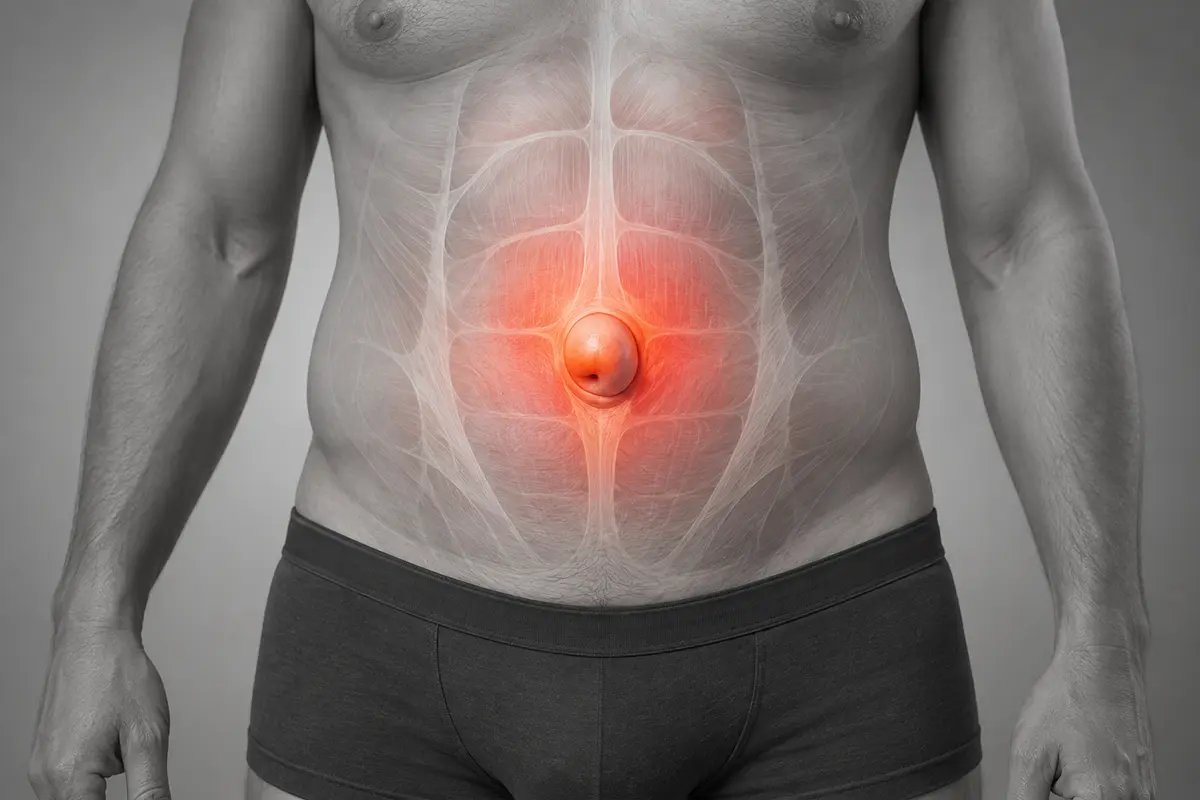
WHAT IS UMBILICAL OR VENTRAL HERNIA SURGERY?
An umbilical or ventral hernia develops when fat, intestine, or another internal structure pushes through a weakness or opening in the abdominal wall. An umbilical hernia occurs at or near the belly button, while ventral hernias can develop elsewhere in the abdominal wall.
These hernias may result from a weakness present since birth or develop over time because of pregnancy, obesity, significant weight changes, chronic coughing, constipation, heavy lifting, or other sources of increased abdominal pressure. A hernia occurring at the site of a previous surgical incision is called an incisional hernia and may require different or more complex repair techniques.
Patients commonly notice a bulge that becomes more prominent when standing, coughing, lifting, or straining. Symptoms may include pain, pressure, tenderness, or a pulling sensation. Some small hernias cause few or no symptoms and may be safely observed, while symptomatic, enlarging, incarcerated, or otherwise concerning hernias may require surgery.
At Compassion Surgical, repair options include:
- Laparoscopic Hernia Repair – repairs the hernia through several small incisions using a camera and specialized instruments
- Robotic-Assisted Hernia Repair – allows the surgeon to perform minimally invasive dissection, suturing, and mesh placement with enhanced visualization and wristed instruments
- Open Hernia Repair – repairs the defect through an incision directly over or near the hernia
- Mesh-Reinforced Repair – uses surgical mesh to strengthen the abdominal wall and reduce the risk of recurrence
- Primary Suture Repair – closes the defect with sutures alone and may be appropriate for selected small hernias
The recommended technique depends on the hernia’s size and location, the condition of the surrounding abdominal wall, prior operations, and individual patient factors.
COMMON REASONS FOR UMBILICAL OR VENTRAL HERNIA SURGERY
Pain or Discomfort
A hernia associated with pain, pressure, tenderness, or a pulling sensation may interfere with exercise, work, or normal daily activities and may benefit from repair.
Progressive Enlargement
Some umbilical and ventral hernias increase in size over time. Larger defects may become more symptomatic and require a more involved repair.
Incarceration or Strangulation
An incarcerated hernia contains tissue that has become trapped and cannot return to the abdominal cavity. If the trapped tissue loses its blood supply, the hernia is strangulated and requires emergency surgery.
Patients should seek urgent medical attention for severe or rapidly worsening pain, a firm or tender bulge that cannot be pushed back in, skin discoloration over the hernia, persistent vomiting, abdominal swelling, fever, or inability to pass stool or gas.
Functional or Appearance-Related Concerns
Some patients pursue repair because the hernia interferes with clothing, physical activity, core function, or the appearance of the abdomen. Insurance coverage for repair based primarily on appearance varies by plan.
Pregnancy and Future Pregnancy Planning
Pregnancy can place additional stress on the abdominal wall and increase the risk of recurrence after repair. When symptoms are mild, elective repair may be postponed until after pregnancy and completion of childbearing. Timing should be individualized according to symptoms, hernia characteristics, and future pregnancy plans.
HOW IS UMBILICAL OR VENTRAL HERNIA SURGERY PLANNED?
The surgeon evaluates the hernia’s size, location, symptoms, and whether it can be reduced. Imaging is not required for every straightforward hernia, but ultrasound or CT may be helpful when the diagnosis is uncertain or the defect is larger or more complex.
The examination also assesses for rectus diastasis, a widening between the abdominal muscles that can occur after pregnancy or weight changes. Rectus diastasis is not itself a true hernia, but its presence may affect the repair plan and risk of recurrence.
Smoking, obesity, poorly controlled diabetes, and other health conditions can increase the risk of wound complications and recurrence. When possible, these factors may be addressed before elective surgery.
HOW IS UMBILICAL OR VENTRAL HERNIA SURGERY PERFORMED?
The operation is performed in an accredited surgical facility. Most laparoscopic and robotic-assisted repairs require general anesthesia. Selected small open repairs may be performed with local anesthesia and sedation.
During minimally invasive repair, the surgeon uses several small incisions to return the hernia contents to the abdomen, close the defect when appropriate, and reinforce the abdominal wall. During open repair, an incision is made directly over or near the hernia, and the defect is closed with sutures, mesh, or both.
Mesh is commonly recommended when it is expected to reduce recurrence. The type and position of the mesh are selected according to the hernia, operative approach, and condition of the surrounding tissue. Suture-only repair may be appropriate for certain very small defects.
Robotic-assisted, laparoscopic, and open repairs can all be effective. No single approach is best for every patient.
WHAT CAN I EXPECT AFTER SURGERY?
Many umbilical and ventral hernia repairs are outpatient procedures, although larger or more complex repairs may require an overnight stay. Operative time ranges from less than an hour for some small repairs to several hours for more involved reconstruction.
Walking is encouraged soon after surgery. Temporary soreness, bruising, swelling, and a firm area or fluid collection near the repair can occur. Some patients undergoing minimally invasive surgery also experience temporary bloating or shoulder discomfort from the gas used during the operation.
Patients with a small, uncomplicated repair may resume light activities within several days and many routine activities within 1 – 2 weeks. Recovery after a larger repair may take several weeks or longer. Lifting and exercise restrictions depend on the repair and should follow the surgeon’s specific instructions.
A postoperative appointment is generally scheduled within 1 – 2 weeks to evaluate healing and discuss progression of activity.
WHAT ARE THE POSSIBLE RISKS?
Potential complications include:
- Bleeding or infection
- Fluid collection or seroma
- Injury to the intestine or nearby structures
- Difficulty urinating
- Blood clots
- Persistent pain or numbness
- Mesh-related complications
- Recurrence of the hernia
- Conversion to an open procedure when necessary for safety
Your surgeon will explain the expected benefits, alternatives, and risks of the recommended approach.
PERSONALIZED UMBILICAL AND VENTRAL HERNIA REPAIR
If you have noticed a bulge or discomfort near your belly button or elsewhere in the abdominal wall, schedule a consultation with Compassion Surgical. Our surgeons can determine whether observation or repair is appropriate and explain your open, laparoscopic, and robotic-assisted treatment options.