
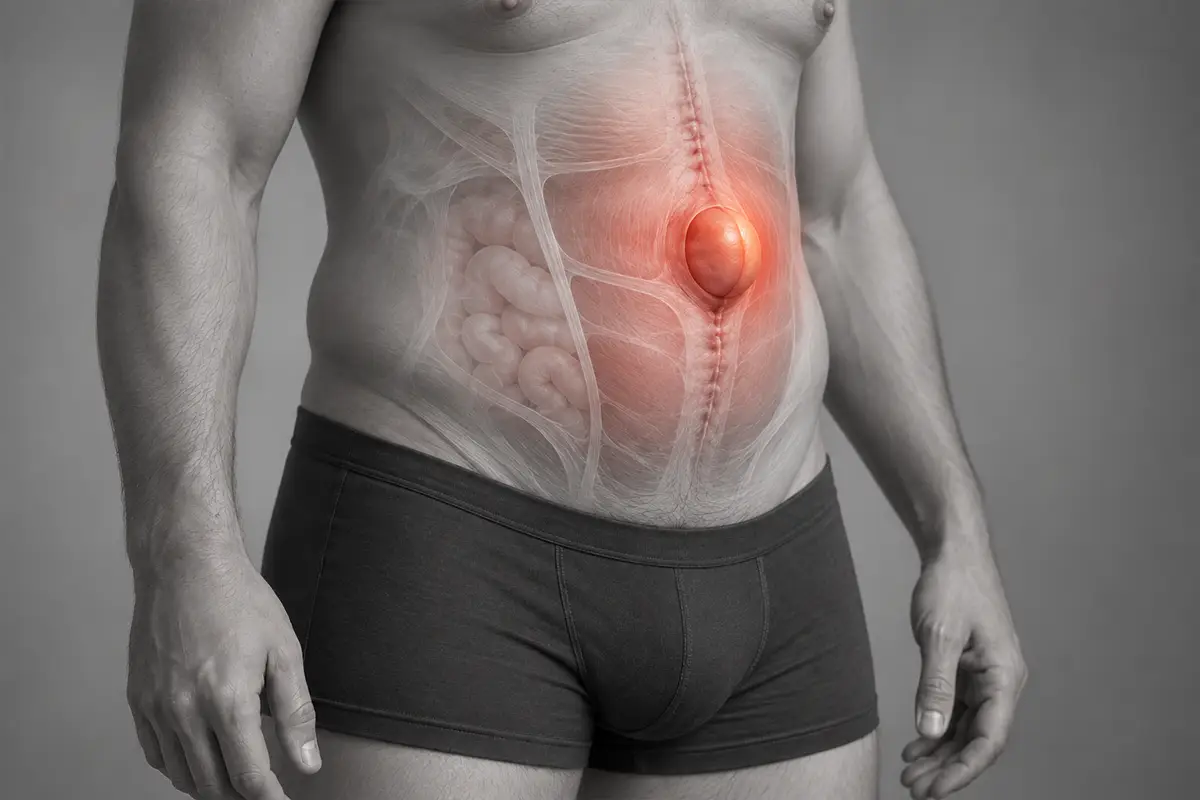
WHAT IS INCISIONAL HERNIA SURGERY?
An incisional hernia develops when fat, intestine, or other abdominal tissue pushes through a weakness at the site of a previous surgical incision. It can develop months or years after the original operation because healed scar tissue does not regain the full strength of the surrounding abdominal wall.
Risk factors include a previous wound infection, obesity, smoking, diabetes, poor nutrition, multiple abdominal operations, and conditions that repeatedly increase pressure within the abdomen.
Patients often notice a bulge along or near a previous scar. The bulge may become more noticeable when standing, coughing, lifting, or straining and may be associated with discomfort, pressure, or a pulling sensation.
Not every incisional hernia requires immediate surgery. Small hernias causing few or no symptoms may sometimes be monitored. Surgery may be recommended when the hernia causes pain, enlarges, limits activity, contains trapped tissue, or affects the patient’s quality of life.
Compassion Surgical offers several approaches to incisional hernia repair:
- Laparoscopic Incisional Hernia Repair – repairs the hernia through several small incisions using a camera and specialized instruments
- Robotic-Assisted Incisional Hernia Repair – uses robotic technology to assist with dissection, closure of the abdominal wall defect, and mesh placement
- Open Incisional Hernia Repair – repairs the abdominal wall through an incision near or over the hernia and may be recommended for large or complex defects
- Abdominal Wall Reconstruction – restores the structure and function of the abdominal wall in selected patients with large or complex hernias
- Component Separation – releases specific abdominal wall muscle and fascial layers so they can be brought together with less tension
- Mesh Reinforcement – reinforces the repaired abdominal wall to reduce the risk of recurrence when appropriate
The operative approach and type of mesh are individualized according to the size and location of the defect, previous repairs, condition of the surrounding tissue, degree of contamination, and the patient’s overall health.
WHEN IS INCISIONAL HERNIA REPAIR CONSIDERED?
Pain or Discomfort
A hernia that causes pain, pressure, or a pulling sensation during daily activities may benefit from elective repair.
Progressive Enlargement
Incisional hernias do not heal on their own and may enlarge over time. Larger hernias can become more difficult to repair and may increasingly affect abdominal wall function.
Functional Limitations
Repair may be considered when a hernia interferes with work, exercise, lifting, posture, core function, or other routine activities.
Recurrent Incisional Hernia
A hernia that returns after a previous repair may require a different operative approach, removal or revision of prior mesh, or advanced abdominal wall reconstruction.
Incarceration or Strangulation
An incarcerated hernia contains tissue that has become trapped and cannot return to the abdominal cavity. If the trapped intestine loses its blood supply, the hernia is strangulated and requires emergency treatment.
Sudden or worsening pain, a firm or tender bulge, skin discoloration, persistent vomiting, abdominal swelling, fever, or inability to pass stool or gas requires urgent medical evaluation.
HOW IS INCISIONAL HERNIA SURGERY PLANNED?
The surgeon evaluates the size and location of the hernia, previous abdominal operations, prior mesh placement, symptoms, and condition of the abdominal wall. CT imaging may be ordered to define the defect and assist with operative planning, particularly for large, recurrent, or complex hernias.
Improving health before surgery can reduce complications and support a more durable repair. Depending on the patient’s circumstances, preparation may include:
- Stopping smoking
- Improving blood sugar control
- Achieving a healthier weight
- Treating active infection
- Improving nutrition
- Managing chronic coughing or constipation
- Reviewing medications that affect bleeding or healing
The timing of surgery balances the patient’s symptoms and risk of complications against the potential benefits of preoperative optimization.
HOW IS INCISIONAL HERNIA REPAIR PERFORMED?
Incisional hernia repair is performed under general anesthesia at an accredited surgical facility.
During laparoscopic or robotic-assisted repair, the surgeon operates through several small incisions away from the hernia. Adhesions are carefully separated, the abdominal contents are returned to their appropriate position, and the defect is closed when feasible. Mesh is then placed in an appropriate layer of the abdominal wall to reinforce the repair.
During open repair, the surgeon works through an incision near or over the hernia. Large or complex defects may require abdominal wall reconstruction or component separation to bring the muscle and fascial layers together without excessive tension.
Some operations require surgical drains to reduce fluid accumulation. The exact technique depends on the anatomy of the hernia and findings during surgery.
WHAT SHOULD I EXPECT AFTER INCISIONAL HERNIA SURGERY?
Incisional hernia repair may be performed as an outpatient procedure or require hospitalization. The operative time and length of stay vary considerably according to the size and complexity of the hernia and whether abdominal wall reconstruction is required.
Temporary pain, swelling, bruising, fatigue, and a firm area near the repair are common. Some patients may be asked to wear an abdominal binder or care for surgical drains during recovery.
Walking is encouraged, but lifting and strenuous core activity are restricted while the repair heals. Patients with smaller minimally invasive repairs may return to many routine activities within a few weeks. Recovery after a large open repair or abdominal wall reconstruction may take considerably longer.
A postoperative appointment is generally scheduled within one to two weeks to evaluate healing, remove drains when appropriate, and provide individualized guidance regarding work, driving, lifting, exercise, and other activities.
WHAT ARE THE POTENTIAL RISKS?
Potential complications include:
- Bleeding
- Infection
- Blood clots
- Fluid accumulation or seroma
- Wound-healing problems
- Injury to the intestine or other nearby structures
- Mesh infection or another mesh-related complication
- Chronic pain or numbness
- Bowel obstruction
- Recurrence of the hernia
- Need for an additional operation
The specific risks depend on the patient’s health, previous operations, hernia complexity, and planned repair.
PERSONALIZED CARE FOR INCISIONAL HERNIAS
If you have developed a bulge, pain, or discomfort near a previous abdominal incision, schedule a consultation at Compassion Surgical.
We will evaluate the size and complexity of the hernia, review any previous operations or repairs, and discuss whether observation, preoperative optimization, minimally invasive repair, or open abdominal wall reconstruction is the most appropriate option.